Financial Stability

About Financial Stability

State Bank of Pakistan (SBP) plays a pivotal role in ensuring stability of the financial sector. As a central bank, banking supervisor, and resolution authority, it has been entrusted with responsibilities to, inter alia, contribute to the stability of the financial system of Pakistan. A sound and stable financial system in turn is a key imperative for monetary and price stability, paving the way for inclusive and sustainable economic development. For this purpose, SBP has instituted both micro-prudential supervision tools (focusing on the soundness of individual institutions) and macro-prudential policy framework which aims to proactively assess and mitigate system-wide risks.

Financial Stability Department (FSD) of SBP is responsible for supporting the formulation and implementation of macro-prudential policy framework. It conducts comprehensive financial stability assessments, evaluates key systemic risks, and the resilience of regulated financial institutions to those risks. It also formulates corresponding policy recommendations. Coordinates the crisis preparedness function as well as various macro-prudential policy initiatives both within and outside SBP.

Financial stability reflects the state in which the financial system - financial intermediaries, financial markets, and financial market infrastructure - aids the smooth flow of funds between savers and investors in a structured and trustful manner. The financial sector is considered stable when financial institutions in general are:

  • Effectively performing the financial intermediation process and are financially sound enough to honour their financial obligations in orderly manner
  • Effectively identifying, managing, and pricing their risks; and,
  • Resilient enough to withstand severe macroeconomic shock(s).

The financial system’s stability is important to:

Loading……

Given the importance of financial system in a well-functioning economy, ensuring the stability of the financial system has emerged as one of the key responsibilities of the central banks and regulatory authorities across the world. To achieve this goal, it is necessary for central banks to proactively identify and redress vulnerabilities which can build over time and across institutions, to preserve both soundness of financial institutions as well as public confidence and limit spillovers of risk and disruptions to other segments of the economy.

The preamble and Section 4B of the SBP Act explicitly delineate the stability of the financial system of Pakistan as one of the key objectives of SBP besides its primary objective of maintaining domestic price stability. Further, Section 4C(j) of the Act, among others, empowers SBP to use necessary macro-prudential tools for this purpose SBP has also developed a Macro-prudential Policy Framework. Furthermore, SBP Strategic Plan 2023-28 also emphasizes strengthening the financial stability framework as a key goal.

In order to ensure stability of the financial system, in general, and the banking sector in particular, an elaborate regime has been put in place at SBP, which comprises:

  • Regulatory standards and guidelines, setting minimum prudential requirements and prescribing best practices to be applied by regulated institutions in line with the principle of proportionality;
  • Risk-based supervision framework which proactively supervises the performance and soundness of regulated institutions and takes corrective actions to redress any supervisory concerns at an early stage. Moreover, this system is augmented by a comprehensive set of additional safety nets i.e., lender of last resort (LOLR) or emergency liquidity assistance facility and deposit protection system, as well as bank resolution and crisis management mechanisms;
  • The regulatory and supervisory regime is complemented by the macro-prudential policy framework which assesses systemic risks (pertaining to both time dimension i.e., business cycle’s dynamics, as well as cross-sectional and structural aspects at aggregate level). The findings of this assessment feed into the regulatory standards to mitigate these risks. The Financial Stability Department carries out macro-prudential supervision of the banking and financial sector and coordinates various initiatives on macro-prudential supervision.

Structure of Financial System of Pakistan

The financial sector of Pakistan mainly comprises banking institutions, development finance institutions (DFIs), microfinance banks (MFBs), non-banking finance institutions (NBFIs), insurance firms, financial markets, and financial market infrastructures. The supervision of financial institutions is entrusted with the SBP and the Securities and Exchange Commission of Pakistan (SECP). Detailed structure is given below.
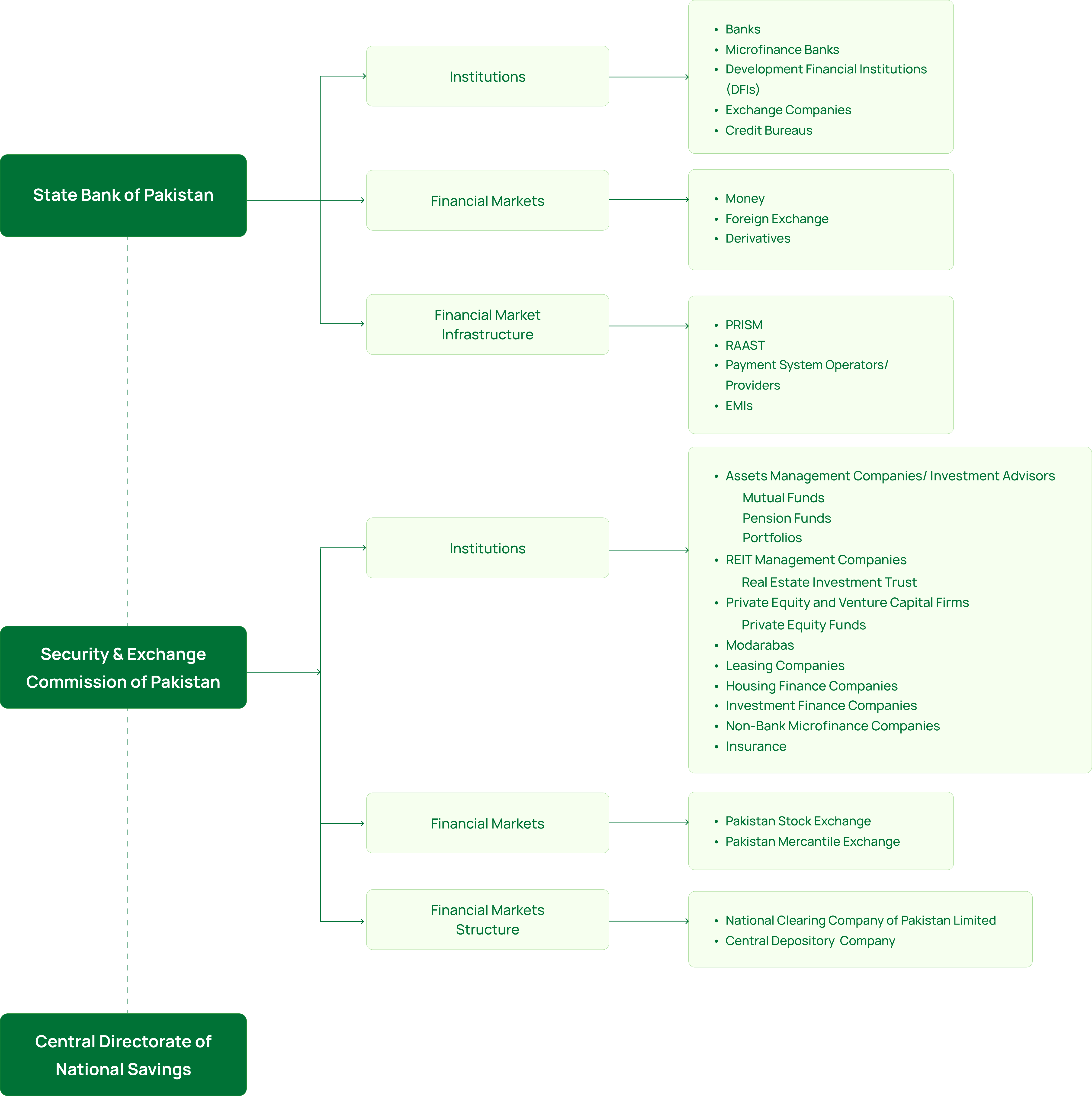


Pakistan’s financial sector is dominated by banks which contribute the largest part of the financial sector’s asset base and play a significant role in both intermediation process and payment system of the country. Therefore, the soundness of banking sector has a profound bearing on the overall financial and economic stability in the country.
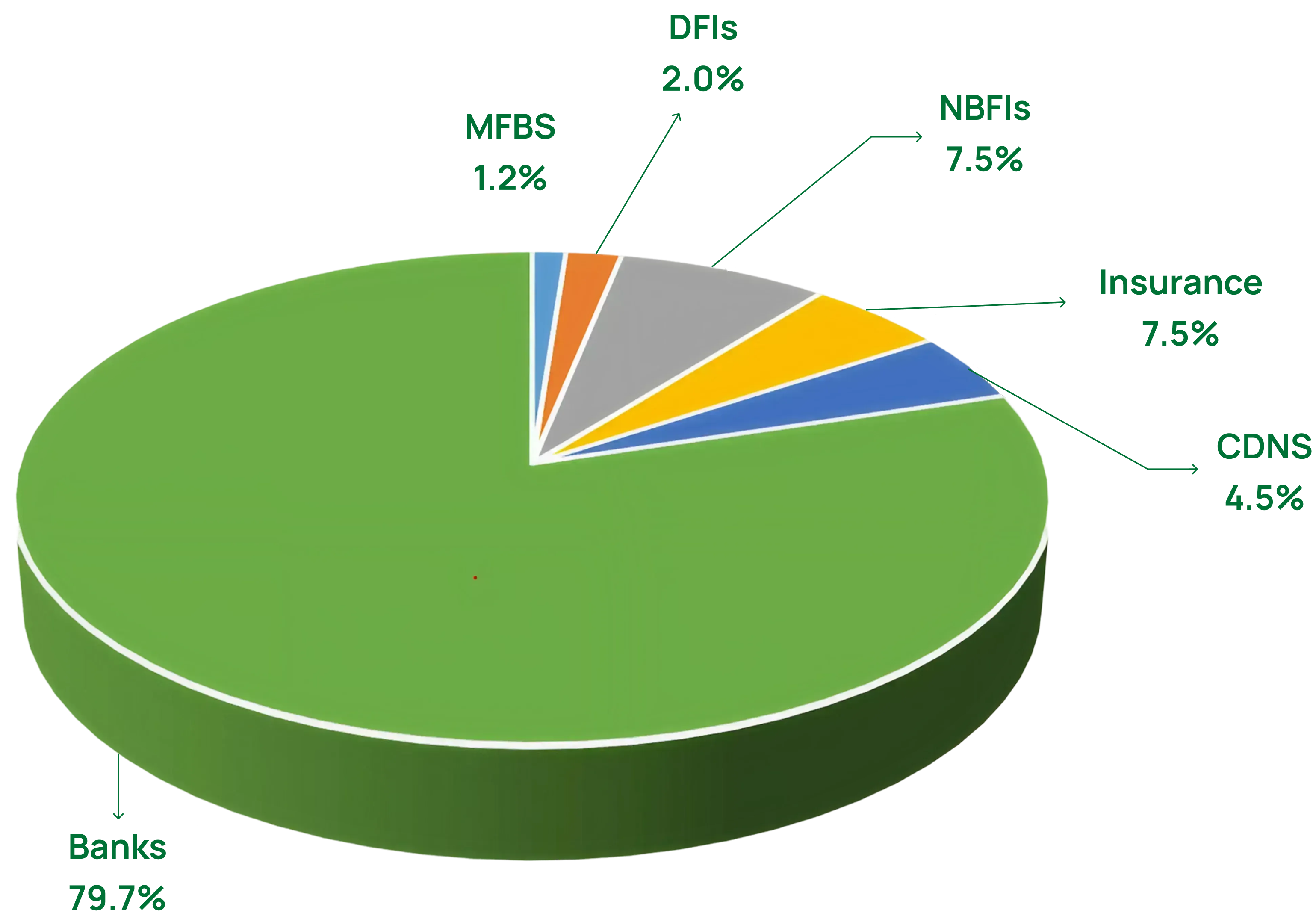
ASSETS COMPOSITION OF FINANCIAL SECTOR AT END JUN - 25

Sources : SBP SECP and CDNS

Financial Stability Assessments

Publications: Periodic Reviews, Reports and Surveys

SBP carries out regular assessments of systemic vulnerabilities and transmission channels of shocks to the financial sector and real economy. Besides informing the policy decisions, the assessments are also shared with market via different publications and data compendium as detailed below:

  • Financial Stability Review
    Financial Stability Review (FSR) is the flagship publication of SBP on financial stability and a statutory report under section 39 of the SBP Act, 1956 (as amended in Jan-2022). The Review assesses the performance and soundness of Pakistan’s financial sector, covering banking sector, microfinance banks (MFBs), non-banking finance institutions (NBFIs), insurance sector, financial markets, and financial market infrastructures. It also provides brief overview of macroeconomic environment in which the financial sector operates and evaluates the performance of non-financial corporate sector (the leading user of bank credit) and covers key emerging issues and systemic risks which may have bearing on financial stability. FSR can be viewed at:
  • Mid-Year Performance Review of the Banking Sector
    SBP publishes a Mid-Year Performance Review of the Banking Sector (MYPR) for the January-June period, analyzing performance and soundness of the banking sector as well as the outlook for the forthcoming period of the calendar year. The latest MYPR can be accessed at
  • Systemic Risk Survey
    SBP conducts biannual (January and July) Systemic Risk Survey (SRS) to gauge the views of market participants and experts on various existing and emerging risks that can potentially affect the stability of the financial system. The results of these surveys are published in annual Financial Stability Review and Mid-Year Performance Review of Banking Sector.
  • Governor’s Annual Report
    Governor’s Annual Report to the parliament is another statutory report under Section 39 of the SBP Act, 1956. It covers the analysis on the achievement of the SBP's objectives, conduct of monetary policy, state of the economy and the financial system. Financial Stability Department (FSD) contributes chapters related to state of financial sector as well as state of stability of SBP regulated financial institutions, financial markets and FMIs. Latest report is available at
  • Quarterly Compendium of statistics and financial soundness indicators (FSIs)
    In order to cater to the information needs of various internal and external stakeholders, SBP compiles and publishes a dataset on key statistics and FSIs of banking sector, development finance institutions (DFIs), microfinance banks (MFBs), other financial institutions, non-financial corporations, etc. in line with IMF’s guidelines. Latest compendium can be accessed at