Financial Markets

Open Market Operations

  • Open Market Operation (OMO) is a tool used by a State Bank to inject or mop-up funds from the banking system via the purchase or sale of eligible securities. The decision to conduct an OMO is based on the SBP’s liquidity assessment of the market
  • Operationally, in case of OMO (Injections), SBP lends funds to banks/PDs against eligible collateral to address liquidity shortage in the system. The eligible securities include MTBs, PIBs and Ijara Sukuk. In OMO for liquidity Mop-up, SBP sells government securities to banks against funds to remove surplus liquidity from the system
  • SBP conducts five types of Open Market Operations (OMOs) to manage system’s liquidity:
Sr.No. OMO Type Purpose Eligible Participants Eligible Collateral
1 Reverse Repo Purchase (Injection) To tackle short position of the market (providing liquidity to the market) Scheduled Banks, DFIs and Primary Dealers Marketable Government Securities (MTB, PIB)
2 Repo Sale (Mop Up) To tackle long position of the market (draining surplus liquidity from the market) Scheduled Banks, DFIs and Primary Dealers Government Securities held by SBP
3 Shariah Compliant Mudarabah based OMO (Injection) To tackle short market position Islamic Banks (IBs) and Islamic Banking Branches (IBBs) GOP Ijara Sukuk, GOP Bai Muajjal, GIS (CDC)
4 Outright Sale/Purchase Long-term liquidity management Scheduled Banks, DFIs and Primary Dealers Marketable Government Securities (MTB, PIB)
5 SBP Bai Muajjal To tackle long market position Islamic Banks (IBs) and Islamic Banking Branches (IBBs) GOP Ijara Sukuk
  • Tenors:There is no restriction on SBP in terms of tenor of conventional OMOs. However, usually SBP conducts OMOs of shorter tenors (e.g. 7 to 14 days)

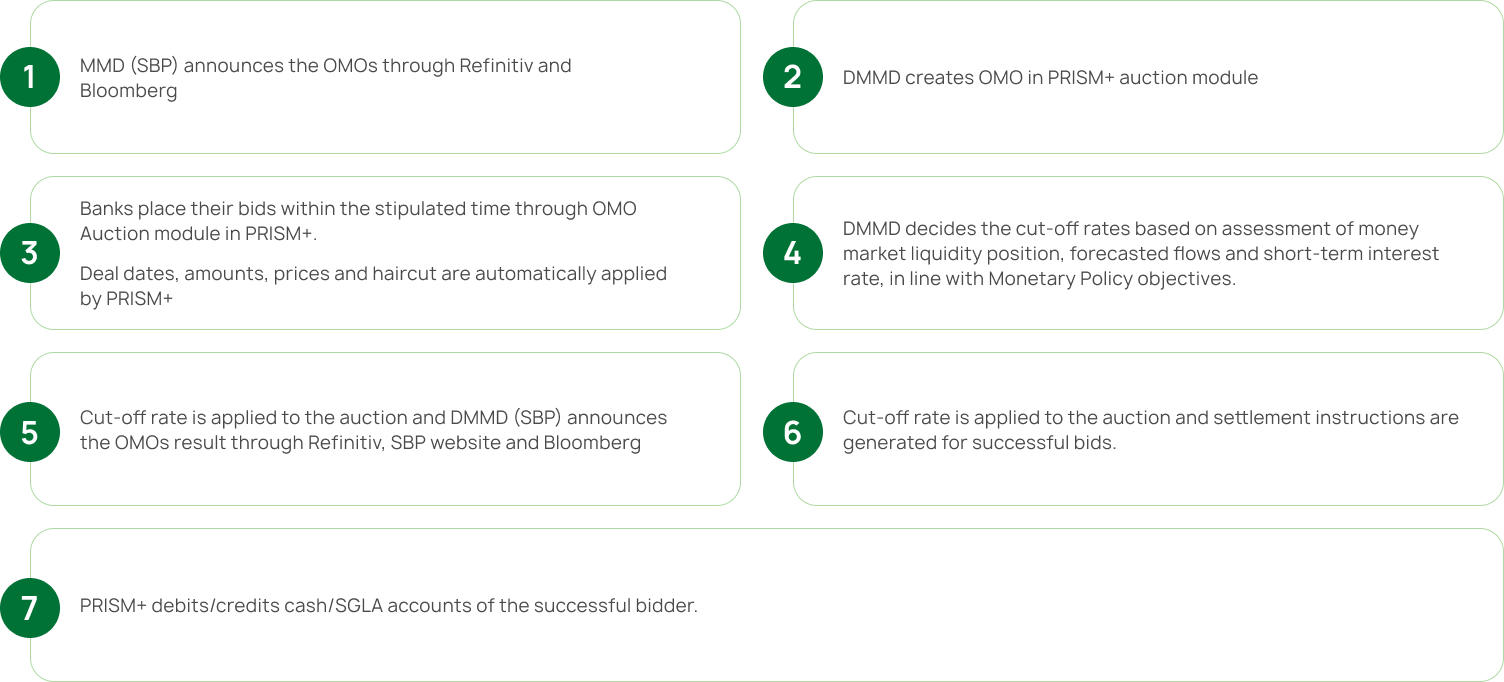
OMO Process Flow

dia-1.jpg

Islamic OMOs

Shariah Compliant Mudarabah Based Open Market Operation-OMO Injection

For Shariah Compliant Open Market Operations (Injections), Mudarabah mode of financing is used to provide liquidity to Islamic Banking Institutions (IBI). Under this transaction structure, SBP being the provider of the funds becomes Rab-ul-Maal while IBI is Mudarib. Similar to conventional OMOs, SBP is conducting Shariah Compliant OMO-Injections based on assessment of market liquidity condition through a multiple price competitive bidding process for tenors as announced by SBP from time to time, against collateral. Once the expected rate of return is finalized through a competitive bidding process, the funds provided by SBP are invested in a pool of high-quality assets by the respective IBI. SBP and IBI agree on a Profit-Sharing ratio at the onset of the transaction.

For more details, DMMD Circular relevant to Shariah Compliant Mudarabah Based Open Market Operations - Injections is available at below mentioned link:
Bai Muajjal

  • Background: SBP introduced OMOs for IBIs in October 2014. Under these OMOs, SBP can purchase GOP Ijara Sukuk (GIS) on deferred payment basis (Bai-Muajjal) for a tenor of up to 1 year and sell GIS on ready payment basis; using competitive bidding auction process. These OMOs provide SBP a tool to manage excess liquidity available with IBIs and improve effectiveness of monetary policy transmission in the absence of regular Sukuk issuances by the GOP
  • Mechanics of Bai-Muajjal Transactions:
    • Under the Bai Muajjal transaction, SBP invites quotes from IBIs to sell their holding of GOP Ijara Sukuk on deferred payment basis to SBP.
    • SBP evaluates and accepts the quotes of participants based on a cut-off price.
    • Successful bidders transfer their GIS holding to SBP on the deal date (which is usually same as auction date). It is important to note that SBP does not pay any cash to the successful bidder at this stage. Rather, SBP only pays the deferred price to IBIs on settlement date (i.e. after one year)

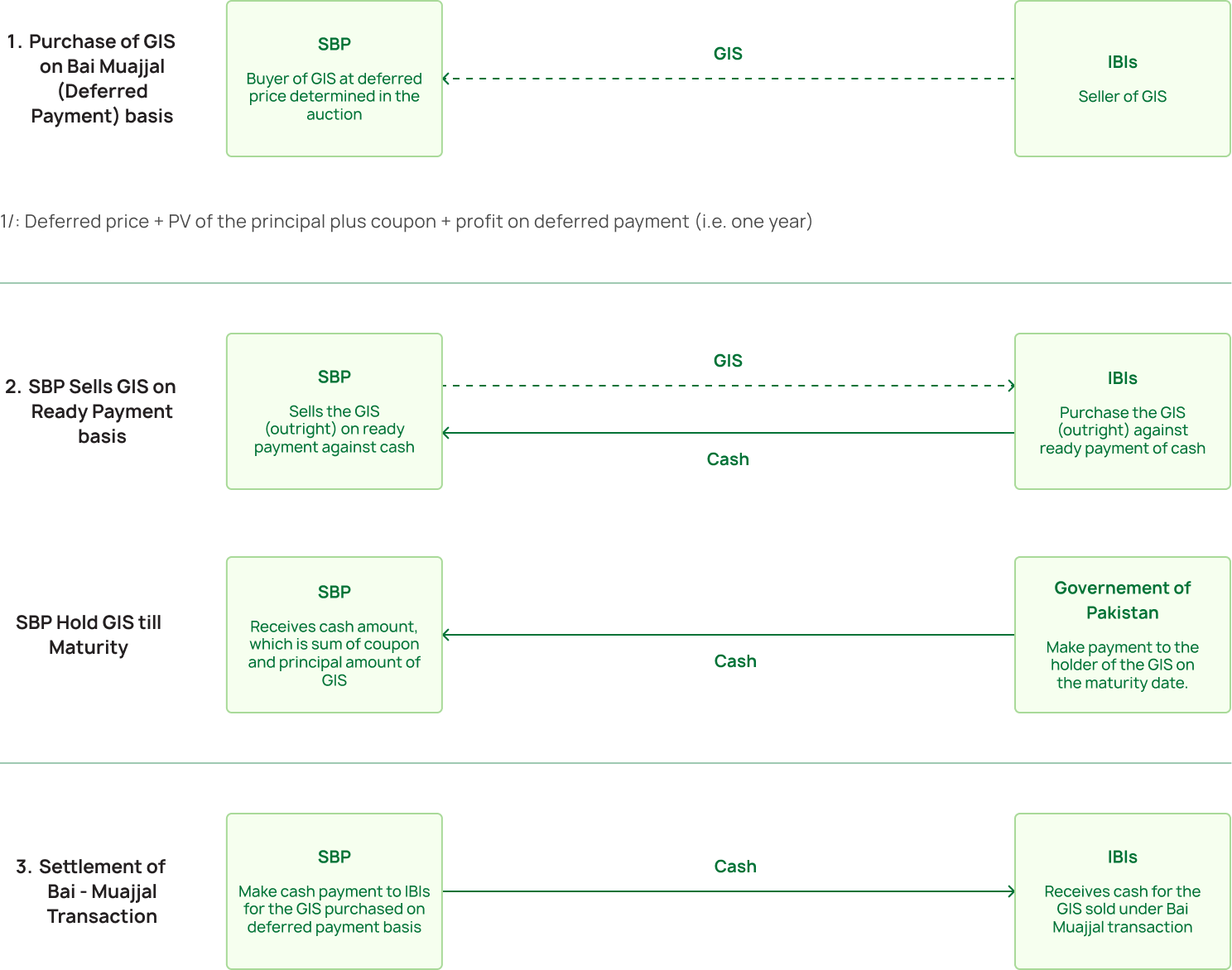
Graphic Illustration of a typical Bai Muajjal Transaction

Interest Rate Corridor

SBP introduced interest rate corridor (IRC) for overnight money market repo rate in August 2009 to bring more transparency in the implementation of monetary policy and to reduce volatility in short term interest rates.

SBP Policy rate: SBP communicates its monetary policy decision in terms of its target policy rate that unambiguously signals SBP’s stance of monetary policy to achieve primary objective of price stability. SBP aims at keeping the money market weighted average overnight repo rate close to the SBP Target rate using liquidity management tools, mainly OMOs and outright sale/purchase of government securities.
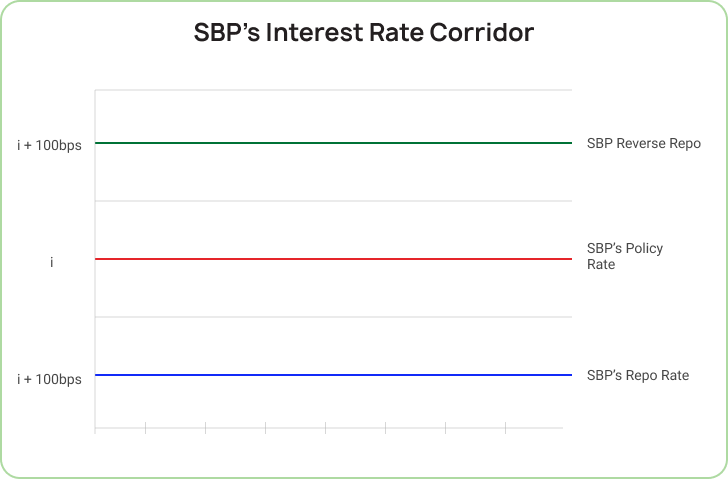
  • Standing facilities: aim to reduce volatility in short term rate by providing and/or absorbing overnight liquidity. These facilities are primarily help in managing bank-specific liquidity requirements as the standing facilities are available to eligible counterparties on their own initiative. These include SBP Reverse repo (Ceiling) facility and SBP Repo (Floor) facility. At present, the ceiling rate is 100 bps above the SBP’s policy rate and the floor rate is 100 bps below the policy rate, which also translates to interest rate corridor of 200bps
    • SBP Reverse repo (Ceiling) rate: At times of liquidity shortage, scheduled banks, PDs and DFIs can access SBP Reverse repo facility to borrow funds against eligible collateral, i.e. marketable government securities (MTB, PFL) from SBP on overnight basis to meet their liquidity requirement. At present, the Ceiling rate is 100bps above the SBP policy rate
    • Shariah-compliant Standing Ceiling Facility: It is an overnight Mudarabah-based financing facility for Islamic banks and Islamic banking branches in line with SBP Reverse repo (Ceiling) facility for conventional banks. The SBP provides funds against eligible collateral (GOP Ijara Sukuk, GOP Bai Muajjal, GIS (CDC)) at an expected profit rate equal to SBP’s Ceiling Rate.
    • SBP Repo (Floor) rate: At times of excess liquidity, scheduled banks and PDs can access SBP repo facility to place their surplus funds against eligible collateral (government securities held by SBP) with SBP on overnight basis. At present, the floor rate is 100bps below the SBP policy rate. At present, the floor facility is available to conventional market only.
    • Visual representation of SBP’s IRC as appended below:
Historical Developments in Interest rate corridor

SBP introduced an interest rate corridor in August 2009 with the twin objectives of bring more transparency in the implementation of monetary policy and to reduce volatility in short term interest rates.

  • Since the implementation of “Interest Rate Corridor” (IRC), volatility in the overnight money market repo rate has reduced.
  • The structure of SBP’s Interest Rate Corridor (IRC) was revised in May 2015 to:
    • Further strengthen transmission mechanism of Monetary Policy
    • Align SBP’s monetary policy operational framework with International best practices
  • A new policy rate as “SBP Target Rate” for the money market overnight repo rate was introduced in within the IRC, i.e. SBP Reverse Repo Rate (ceiling rate) and the SBP Repo Rate (floor rate) of the corridor. This O/N repo rate target is a single policy rate to unambiguously signal SBP’s stance of monetary policy.
  • SBP aims to keep the money market weighted average overnight repo rate close to the SBP Target rate to unambiguously implement the SBP’s monetary policy stance.
    Effective from Mar 18, 2020, SBP has decided to make the interest rate corridor symmetric around the policy rate.

Cash Reserve Requirements

  • DFIs are required to maintain CRR at 1 percent of their demand and time liabilities
  • Banks are required to maintain cash reserve requirement of 5 percent of their DTL (demand liabilities and time deposits with tenor of less than 1-year). In addition, conventional banks are required to maintain Statuary Liquidity Requirement (SLR) at 19 percent of the DTL, while Islamic banks are requirement to maintain SLR at 14 percent of their DTL. of and 15 percent as special cash reserves against foreign currency deposits
  • For the purpose of applicable DTL for CRR, Time and Demand Liabilities (TDL) as of close of business on Friday (first day of reserve maintenance period) is taken into account for determination of required CRR
  • It is also pertinent to mention that SBP does not remunerate required or excess reserves