

RUDRADAM SILVER DRACHM
Obverse: Bust of King in traditional Gupta style
Reverse: Trident with legend around


The Scythian Western Kshatraps were not conquered and even survived the Kushan Empire, of which they were either vassals or allies. Kushan suzerainty is attested by some documents only during the rule of Kanishka I, when Saka rulers governed the western and central parts of India (including southern Sindh). There were 27 independent Western Satrap rulers over a period of 350 years. They initially belonged to the Kshaharata dynasty (mentioned in the 6 CE Taxila Copper Plate inscription), founded by Nahapana, who used only the title of Satrap on his coins, not Raja or Rano (King).
The Kardamaka dynasty, the family of Castana (2nd–4th century CE), was established by “Satrap” Castana around 130 CE. He was the Satrap of Ujjain.
Around 130 CE, Rudradaman I, the grandson of Castana, took the title “Mahakshatrapa” (Great Satrap) and defended his kingdom from the Satavahanas. Rudrasena II (256–278 CE) brought the dynasty to its peak. The last ruler of this family was Visvasena.
The Kshatrapas have a rich and interesting coinage tradition based on Indo-Greek models, featuring Greek or pseudo-Greek legends and lifelike royal busts on the obverse. The reverse is distinctive and depicts a thunderbolt and an arrow, and later a chaitya (three-arched hill) and river symbol with a crescent and sun, surrounded by a Brahmi legend. These coins are highly informative, recording the name of the king, his father, and the date of issue.
Regnal dates: Beginning with Rudrasimha I, the date of minting of each coin was written on the obverse behind the king’s head in Brahmi numerals, an uncommon practice in Indian numismatics.
The coins of Nahapana bear the Greek legend “PANNI IA HAPATAC NAHA ANAC” (Rano Kshaharatasa Nahapanasa), dating to the reign of the Kshaharata ruler Nahapana. Castana also issued coins with the legend “PANNI IATPA AC CIASTANCA” (Rano Kshatrapasa Castana) during his rule as Satrap.
The coinage traditions of the Kshatrapas were later adopted by the Satavahanas and the Guptas, as seen in the silver coins of Chandragupta II and his son Kumaragupta I.
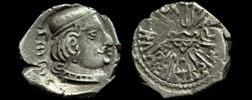
Obverse: Bust of King in traditional Gupta style
Reverse: Trident with legend around
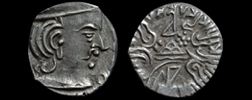
Obverse: Bust of King in traditional Gupta style
Reverse: Trident with legend around
The Parthian and Kushan domains were superseded by the Sassanids.
In the Indus Valley, the Sassanids conquest did not completely obliterate the Kushan Kingdom, which survived at the east of Indus till 320 CE and the Scythian Western Ksharapas, ruled until 405 CE. The collapse of Kushan enabled the expansion of Gupta Empire upto Sutlej Indus Line.
The Guptas arose as the rebuilders of Maurayan Empire. They achieved in ruling over the territories which were once ruled by Maurayas, after the five centuries of foreign dominion.
Hunas or “White Huns”, determined the end of the Gupta Empire, settled capital at Sakala (Sialkot). Descending from Central Asia invaded Sassanian Empire in 425 AD.
Contemporary with later Hephthalite period and ending stage of Sassanid rule, the Rai dynasty, a Mauryan Line of Kings reigned over Sindh. The Sassanid Empire fell under the Arabs.
The Huns were instrumental in circulating the currency of Sassanian types in India. These Sassanian coins became prototype throughout the Rajputana Region.